|

Monday, May 24, 2010
Are You in the Zone?
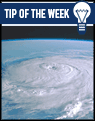 Did you know that 2.3 million New Yorkers live in coastal evacuation zones? This week is Hurricane Preparedness Week and OEM encourages New Yorkers to find out if their neighborhoods are at risk. Enter your addresses into the

Hurricane Awareness Week
FEMA Private Sector Tip of the Week 05/24/10: During the 2010 Hurricane Awareness Week, learn how to prepare your business, non-profits and schools for hurricanes: http://go.usa.gov/3YI
FEMA · U.S. Department of Homeland Security · Washington, DC 20472

FEMA · U.S. Department of Homeland Security · Washington, DC 20472
Monday, May 17, 2010
Get What You Need to Know, When You Need to Know It
|
 Last weekend, 45,508 people received texts, e-mails, phone messages, and tweets about the Staten Island Ferry accident. Sign up for Notify NYC so you can receive updates about emergencies affecting your neighborhood.
Prepare for Fires
Prepare your employees for fires by placing a fire extinguisher in your office; identify the exit routes out of buildings and ensure that all fire protection equipment is in proper working order. Visit the US Fire Administration "Wild Fire, Are you Prepared?" web site for more details: www.usfa.dhs.gov/citizens/all_citizens/home_fire_prev/wildfire/

FEMA · U.S. Department of Homeland Security · Washington, DC 20472

FEMA · U.S. Department of Homeland Security · Washington, DC 20472
Monday, May 10, 2010
Engage Your Elders in Emergency Preparedness
|
 May is
 Check out your local CERT
FEMA Private Sector Division Tip of the Week for 05/10/2010:
Businesses and non-profits may obtain local hazards information and basic disaster response training for their employees from their local Community Emergency Response Team (CERT). Select the State Directory to find your nearest local CERT program: www.citizencorps.gov/cert.
FEMA · U.S. Department of Homeland Security · Washington, DC 20472
Businesses and non-profits may obtain local hazards information and basic disaster response training for their employees from their local Community Emergency Response Team (CERT). Select the State Directory to find your nearest local CERT program: www.citizencorps.gov/cert.
FEMA · U.S. Department of Homeland Security · Washington, DC 20472
Monday, May 3, 2010
Could It Be Something in the Air?
|
 This week is National Air Quality Awareness Week. Not only can high temperatures cause heat illness like heat stroke and exhaustion, they can also create poor air quality. Warm air traps pollutants including ozone near the ground, which can cause problems especially for those with respiratory conditions.
Donate to Help With Disasters
FEMA Private Sector Tip of the Week 05/03/10:
Are you looking for the best way to donate your time and resources to support disasters? Click here for more details: www.fema.gov/donations.
FEMA · U.S. Department of Homeland Security · Washington, DC 20472

Are you looking for the best way to donate your time and resources to support disasters? Click here for more details: www.fema.gov/donations.
FEMA · U.S. Department of Homeland Security · Washington, DC 20472
Monday, April 26, 2010
Listen In When the City Speaks Out
|
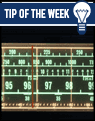 Battery-operated radios help residents stay informed during an emergency because radio stations can broadcast even when the power is out. For children of the Internet era, however, zeroing in on the right station may seem like a maddening game of radio roulette.
 School Safety Tips
Tip of the Week for 4/26/2010:
Prepare your students and educators for all hazards with school safety tips from the Department of Education. http://www2.ed.gov/admins/lead/safety/emergencyplan/index.html.
FEMA · U.S. Department of Homeland Security · Washington, DC 20472

Prepare your students and educators for all hazards with school safety tips from the Department of Education. http://www2.ed.gov/admins/lead/safety/emergencyplan/index.html.
FEMA · U.S. Department of Homeland Security · Washington, DC 20472
Monday, April 19, 2010
Make the City Greener (and More Absorbent)
|

Earthquake Protection
Tip of the Week for 4/19/2010:
Help protect your employees and your office building from earthquakes and other disasters with FEMA Mitigation Publications. Click here for more details: http://www.fema.gov/plan/prevent/howto/index.shtm.This service is provided to you at no charge by FEMA.
FEMA · U.S. Department of Homeland Security · Washington, DC 20472
Subscribe to:
Posts (Atom)
![[Valid Atom 1.0]](http://sites.google.com/site/fpcbrooklynyouth/valid-atom.png "Validate my Atom 1.0 feed")
|

|
Scanned with BrokenLinkCheck.com |

 Subscribe to this Blog's Feed